
The Mindset That led to Democratic Socialism in America
is government a provider or a protector?
Contributing Writer
Holly Jean SotoThe Democratic Socialists of America aren't just winning elections.
They're winning something even more important: the battle over how young Americans see themselves.
Over the past decade, DSA membership has surged to120,000, and a third of Democrats identify as democratic socialists. If we want to understand why, we have to look beyond policy proposals because before socialism becomes an economic system, it first takes root as a mindset.
The Dsa and Gen z
In a CBS interview, Grace Mausser, co-chair of the New York City DSA, gives insight into why millennials and Gen Z are increasingly embracing socialism.
"Millennials and Gen Z…see that what we were told as children and teenagers about what would be accessible to us if we worked hard and did all the right things is simply not true. The economy isn't working. It doesn't matter if you have a college degree or you went to trade school or you did all the things that you were supposed to do…What we need and deserve is a government that steps in and steps up and takes a handle on the economy. "
Mausser’s message begins with the belief that America’s economic system is fundamentally stacked against ordinary people—that no matter how hard they work, getting ahead is beyond their control.
The conclusion follows: if individuals can't solve their own problems, government must.

Adobe
The rise of democratic socialism isn’t just a political story, it’s a cultural one. Before people embrace an economic system, they first embrace the worldview that makes it seem necessary.
Today, two fundamentally different ways of seeing the world are competing for the hearts and minds of the next generations.
The First Worldview: Government as Protector
Every political philosophy begins with a belief about human nature and the purpose of government. The classical liberal tradition begins with the belief that people are naturally free. Every person possesses natural rights that preexist government.
Governments don’t grant these rights because they are inherent to every human being.
Liberal philosopher, John Locke, argued that we are born with the natural rights to life, liberty, and property. Since the government cannot take credit for them, its purpose is simply to protect them. This leads to a fundamentally different understanding of government: its role is to create conditions where free people can build businesses, create wealth, own property, innovate, provide for their families, solve problems, and pursue their own goals—not to provide those things on their behalf.
Government exists to protect the freedom and opportunity that allow individuals to become providers themselves, not to make them permanently dependent on government to provide life's necessities.
The Second Worldview: Government as Provider

Bing Guan/Reuters
The socialist tradition begins from a very different premise. It meets people in the middle of very real economic hardship—when consumer prices are 3.5% higher than this time last year, rents have more than doubled since 2005, and grocery prices have risen25.5%over the past two years—and instead of empowering them to improve their circumstances, tells them the system is so rigged against them that their choices no longer matter and their only hope is government.
Mausser’s description of today's economy captures an entire worldview. It teaches young people that hard work, personal responsibility, and the choices they make about schooling, career paths, and their future are ultimately not enough.
Rather than encouraging young people to believe they can improve their circumstances, this somber perspective fosters a sense of hopelessness and discouragement, where hope gradually shifts away from individual responsibility and toward the belief that the government must provide the solution.
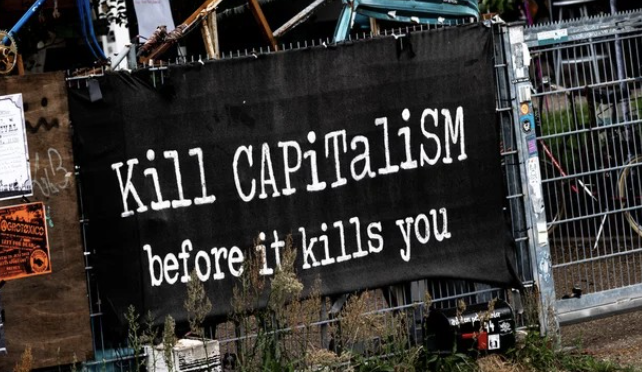
The DSA reinforces this worldview throughout its platform by portraying capitalism as the villain, profit as exploitation, private ownership as injustice, and billionaires as the reason that ordinary people struggle.
Once people become convinced that the system itself is fundamentally rigged against them, the natural conclusion is that government, rather than individual effort, is the answer.
That is how the government’s role slowly transitions from protector to provider.
We've Reversed the Role of Government
These two worldviews don't simply lead to different public policies, but different understandings of what government is supposed to do.
If the government's primary role is to protect our freedom, then it shouldn't begin by asking, "How do we build everyone a house?" It should ask, "Why is housing so expensive in the first place?" Instead of asking, "How do we pay everyone's medical bills?" it should ask, "What barriers have made healthcare so expensive?" The goal isn't simply to provide the outcome. It's to remove the unnecessary obstacles that prevent people from achieving those outcomes themselves.
Adobe
Ultimately, these two worldviews teach people to look in completely different directions. One encourages people to look first to liberty, opportunity, entrepreneurship, voluntary cooperation, families, communities, and personal responsibility. The other encourages people to look first to politics, redistribution, and government programs for security and solutions.
The latter worldview is evident in the way some young socialists describe their expectations of government. As one self-identified socialist, Luc, argued during Jubilee’s 1 Capitalist vs. 20 Anti-Capitalists debate, “We shouldn’t have to earn the right to healthcare… We just want to live. Just exist.
That may be the biggest difference of all. Socialism doesn't simply change public policy—it changes where people place their hope.
Which Worldview Will Shape America’s Future?
The most important question isn't whether the next generation will support one policy or another, rather will they adopt this mindset before they ever cast a vote?
Will they see themselves primarily as people who depend on the government to provide for them, or as free individuals, capable of creating value, solving problems, and building a better future for themselves and others?
A healthy government is not measured by how much it gives people, but by whether it creates an environment where people have the freedom and opportunity to succeed on their own. This understanding begs the question: which future is one worth pursuing and protecting — one in which the government becomes our provider, or one where the government protects our freedom to provide for ourselves?
If you enjoyed reading this article and would like to help Young Americans Against Socialism create more resources like this, please donate to our cause!